

Article
Featured Article — german
Featured Article — English Translation
Portrait: Usman Anees
Debut in Dubai
Famous concert pianists like Daniil Trifonov, Yuja Wang, or Kit Armstrong come from Russia, China, or the West. Never from Pakistan. Usman Anees is changing that.
By Thilo Komma-Pöllath
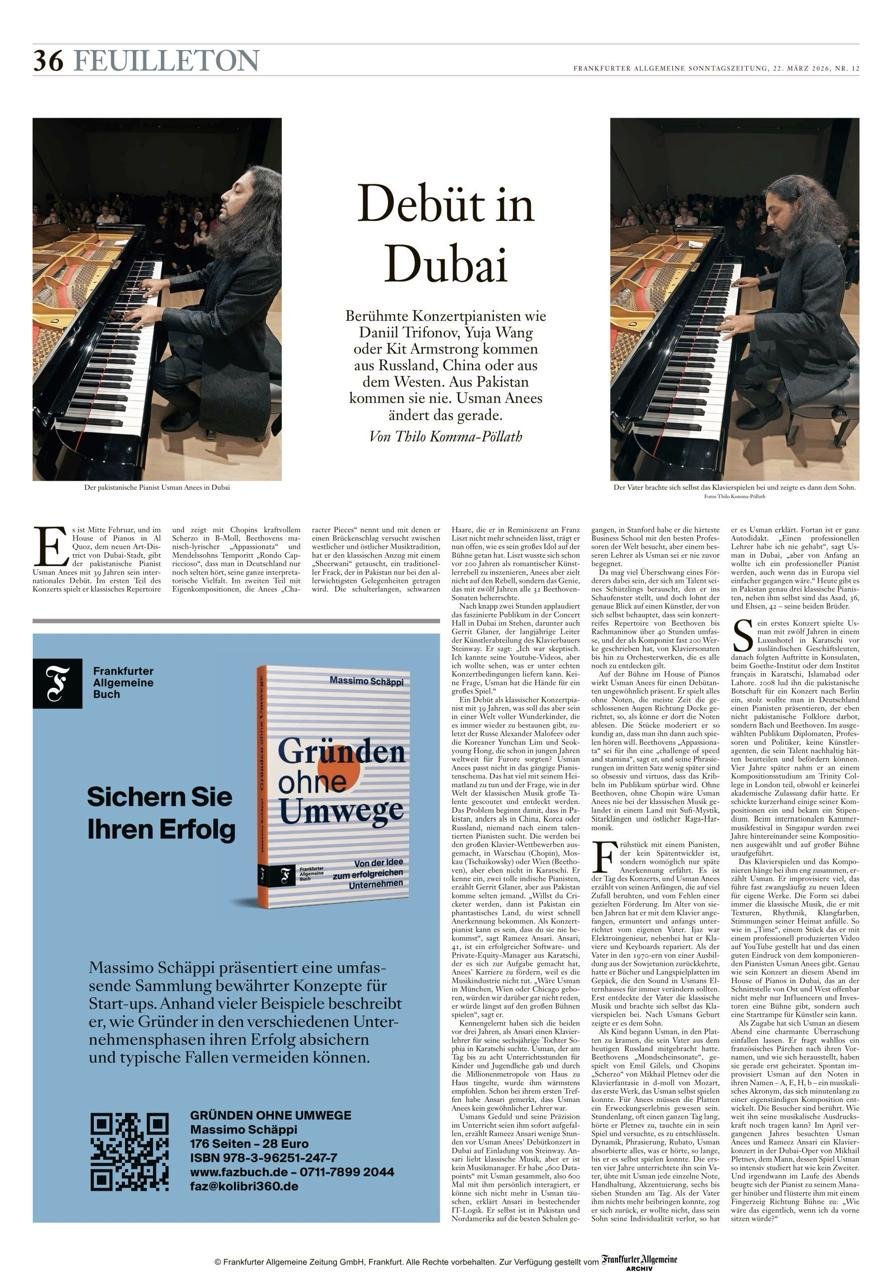
It is mid-February, and at the “House of Pianos” in Al Quoz, the new art district of Dubai, the Pakistani pianist Usman Anees, at 39 years old, is making his international debut. In the first part of the concert, he plays the classical repertoire, showcasing his full interpretive range with Chopin’s powerful Scherzo in B minor, Beethoven’s manic-lyrical “Appassionata,” and Mendelssohn’s tempestuous “Rondo Capriccioso”—pieces that are rarely heard in Germany anymore. In the second part, with his own compositions, which Anees calls “Character Pieces,” he attempts to bridge Western and Eastern musical traditions. He has swapped the classical suit for a “Sheerwani,” a traditional frock coat worn in Pakistan only on the most important occasions. His shoulder-length black hair, which he no longer cuts in reminiscence of Franz Liszt, he now wears openly, just as his great idol did on stage. Liszt knew how to present himself as a romantic artist rebel over 200 years ago, but Anees is not aiming to be a rebel—rather, he is the genius who mastered all 32 of Beethoven’s sonatas by the age of twelve.
After nearly two hours, the fascinated audience in Dubai’s Concert Hall gives a standing ovation, including Gerrit Glaner. Few know young pianistic talents as well as the long-time head of the artist department at the piano manufacturer Steinway. He says, “I was skeptical. I knew his YouTube videos, but I wanted to see what he could deliver under real concert conditions. There’s no question, Usman has the hands for a great performance.”
And yet: A debut as a classical concert pianist at 39 years old—what does that mean in a world full of prodigies, with an emphasis on children, as we continue to marvel at, most recently with the Russian Alexander Malofeev or the Koreans Yunchan Lim and Seokyoung Hong, who caused a sensation worldwide as minors? Usman Anees does not fit the typical pianist mold. This has much to do with his home country and the question of how great talents are scouted and discovered in the world of classical music. The problem begins with the fact that in Pakistan, unlike in China, Korea, or Russia, no one is looking for a talented pianist. These talents are identified at major piano competitions in Warsaw (Chopin), Moscow (Tchaikovsky), or Vienna (Beethoven), but not in Karachi. Gerrit Glaner mentions knowing one or two brilliant Indian pianists, but Pakistan is a blank sheet of music, an exotic in the world of classical music. “If you want to become a cricketer, Pakistan is a fantastic country; you will quickly gain recognition. As a concert pianist, you might never get it,” says Rameez Ansari, adding, “If Usman had been born in Munich, Vienna, or Chicago, we wouldn’t even be having this conversation; he would already be playing on the big stages.” Ansari, 41, is a successful software and private equity manager from Karachi who has made it his mission to promote Anees’ career because the music industry does not.
The two met three years ago when Ansari was looking for a piano teacher for his six-year-old daughter Sophia in Karachi. Usman, who gave up to eight hours of lessons a day for children and teenagers and traveled from house to house across the metropolis, was warmly recommended to him. From their first meeting, Ansari noticed that Usman Anees was no ordinary teacher. Usman’s patience and precision in teaching immediately stood out, something uncommon in flamboyant Pakistan, Ansari recounts a few hours before Usman Anees’ debut concert in Dubai at the invitation of Steinway. Ansari loves classical music but is not a music manager. He has collected “600 data points” with Usman—meaning he has interacted with him personally 600 times—and he can no longer be mistaken about Usman, Ansari explains with compelling IT logic. He himself attended the best schools in Pakistan and North America and studied at Stanford, which has the world’s best business professors, but he had never encountered a better teacher than Usman. Ansari does not want to limit this to Usman’s piano playing alone.
Pianist Between Sufi and Beethoven
There may be some exuberance from a patron who is intoxicated by the talent of his protégé, whom he is putting in the spotlight, but a closer look at an artist who claims his concert-ready repertoire from Beethoven to Rachmaninoff spans over 40 hours and who, as a composer, has written nearly 200 works—from piano sonatas to orchestral pieces that are all yet to be discovered—is worthwhile. On stage at the “House of Pianos,” Usman Anees appears unusually present for a debutant. He plays everything from memory, most of the time with his eyes closed and directed toward the ceiling, as if he could read the notes there. He introduces the pieces so knowledgeably that you want to hear him play them. Beethoven’s “Appassionata” is, for him, a “challenge of speed and stamina,” he says, and his phrasing in the third movement shortly afterward is so obsessive and virtuosic that the tension in the audience is palpable. Without Beethoven, without Chopin—and this is the beginning of his story—Usman Anees would never have found his way to classical music in a country steeped in Sufi mysticism, sitar sounds, and Eastern raga harmonies.
Breakfast with a pianist who is not a late bloomer but perhaps only receives late recognition. It is the day of the concert, and Usman Anees talks about his beginnings, which were based on much coincidence and the lack of targeted support. At the age of seven, he started playing the piano, encouraged and initially taught by his own father. Ijaz was an electrical engineer who also repaired pianos and keyboards on the side. When his father returned from training in the Soviet Union in the 1970s, he brought books and vinyl records that would forever change the sound in Usman’s parents’ home. First, the father discovered classical music and taught himself to play the piano.
After Usman’s birth, history repeated itself.
As a child, Usman began rummaging through the records his father had brought back from what is now Russia. Beethoven’s Moonlight Sonata, played by Emil Gilels, Chopin’s Scherzo by Mikhail Pletnev, or Mozart’s Piano Fantasy—the first piece Usman himself could play. For Anees, the records must have been an awakening experience. For hours, often a whole day, he listened to Pletnev, immersing himself in his playing and trying to decipher it. Dynamics, phrasing, rubato—Usman absorbed everything he heard until he could play it himself. For the first four years, his father taught him, practicing every single note, every hand position, and accentuation with Usman, six to seven hours a day. When his father could no longer teach him anything, he stepped back, not wanting his son to lose his individuality, as he explained to Usman. From then on, he was entirely self-taught. “I never had a professional teacher,” says Usman in Dubai, “but from the beginning, I wanted to become a professional pianist, even if it would have been much easier in Europe.” Today, there are exactly three classical pianists in Pakistan: besides himself, there are Asad, 36, and Ehsen, 42—his two brothers.
Usman gave his first concert at the age of 12 in a luxury hotel in Karachi for foreign businesspeople, followed by performances at consulates, the Goethe Institute, or the Institut français in Karachi, Islamabad, or Lahore. In 2008, the Pakistani Embassy invited him to perform in Berlin, proudly presenting a pianist in Germany who did not offer Pakistani folklore but Bach and Beethoven. The selected audience consisted of diplomats, professors, and politicians—no artist agents who could have sustainably assessed and promoted his talent. Four years later, he participated in a composition study program at Trinity College in London, even though he had no academic qualifications for it. He simply sent in some of his compositions and received a scholarship. For two consecutive years, his compositions were selected and premiered on a grand stage at the International Chamber Music Festival in Singapore.
Playing the piano and composing are closely linked for him, Usman explains over a second cup of coffee. He improvises a lot, which almost inevitably leads to new ideas for his own works. The form is always classical music, which he fills with textures, rhythms, timbres, and moods from his homeland. As in “Time,” a piece he posted on YouTube with a professionally produced video, giving a good impression of Usman Anees, the composing pianist. Just like his concert that evening at the “House of Pianos” in Dubai, which apparently not only provides a stage for influencers and investors at the intersection of East and West but can also serve as a launching pad for artists who
can be heard from here toward the West.
As an encore on this Valentine’s evening, Usman has prepared a charming surprise. He randomly asks a French couple for their first names, and as it turns out, they have just gotten married.
Spontaneously, Usman improvises on the notes in their names—A, E, H, B—creating a musical acronym that develops into an independent composition over several minutes. The audience is moved, and even the piano expert and Steinway consultant Gerrit Glaner cannot remain entirely unaffected. The legendary piano manufacturer from Hamburg has organized numerous regional and national piano competitions and concert series to promote young talent (“Steinway Prizewinner Concerts Network”), so Glaner has experienced and accompanied many shooting stars at the piano at a very young age, such as Lang Lang, Igor Levit, Yuja Wang, or Khatia Buniatishvili—a
39-year-old Pakistani had not been among them until now. “A convincing pianist projects,” explains Glaner. “He throws something to me, captures and reaches me as a listener. He becomes the medium for the inner power of his music. That’s what it’s about, and Usman succeeded in that today.”
How far can his inner musical power take him? In April of last year, Usman Anees and Rameez Ansari attended a piano concert at the Dubai Opera by Mikhail Pletnev, the man whose playing Usman had studied as intensively as anyone else. And at some point during the evening, the pianist leaned over to his manager and whispered, pointing toward the stage, “What would it be like if I were sitting up there?”